Saturday, 15 October 2011

Day 8, Sept 15 – Dry river bed bush camp to Otjihaa bush camp

We left the dry river bed early in high spirits.  We retraced our steps back to the intersection where we left the main track to Otjitanda and continued over what would prove to be the most difficult terrain.  First I snapped a few photos hanging out the window looking back.
Bertie going over a rough spot

Then we came to a particularly difficult spot and stopped. The lazy photographer thought it was time to get out of the car for some action shots.
Rocky road to say the least!
No problem for Salome and her land cruiser!
Tom negotiating a tricky spot
Needless to say, we weren't making very good time on this stretch of road known as the D3703. I noticed on the Garmin "tracks for Africa" map that it was "not recommended".  However, it was the shortcut to the Marienfluss valley and without taking it we would have had to go all the way to Opuwo, which was about 240 km from Okongwati to the Red Drum cutoff whereas this route was just 75 km.  The shortcut took us through a series of small mountains and rocky outcrops.


Road through surrounding mountains
Road conditions were also affected by the large amount of rain Namibia had during the last year and these roads aren't well maintained or frequently travelled.  The only people we met were two Himba men who watched us drive by with a great deal of curiosity.

Before leaving this difficult section of road, we had to make a steep and rocky ascent.
View of rocky ascent from my seat
This section got lots of discussion.  I took pictures of all the vehicles making the ascent.
Tom building speed
Roelof starting to ascend while Martie looks on
Roelof nearly up
Nico with trailer behind. Front tire off the ground. Should be an Isuzu advert!
Nico and Rita nearly up.  Rykie looking on.
Waiting at top for Nico. All vehicles up safe.
At about 11 am the worst is finally behind us.  We found a nice shady area for a break.  Later Nico said if he had known the road was going to be so rough he wouldn't have brought the trailer.  Roelof loved it and was ready for more challenges!  We were all full of adrenalin and at the same time relieved to have made it without incident.
Break time!
We made it to Otjitanda about 12:30 and with all respect, Otjitanda wasn't exactly the biggest town I've been in.  It was comprised of a shop, what looked like a couple of storage sheds, and a tent.  We thought we would take a chance on getting Leon and Martie's tire fixed.  Since one of their tires was ruined by the sidewall puncture they wanted to take the damaged tire off the rim and put their good spare on.   With no power tools, other than an air compressor that ran off a car battery, this turned out to be an enriching cultural experience.

Otjitanda receptionists
Life in Otjitanda just as we arrive
We start the delicate process of removing the tire from the rim.  Roelof, behind the wheel, is the technician in charge. 

Interested villagers start gathering
Making progress!
An interesting Himba custom is that the men carry a walking stick.  Nico was well aware of this and came prepared.  Several of the men in Otjithanda carried sticks and Nico fit right in
Nico with "special" walking stick
Village chief? With walking stick like Nico's
I suspected the man in the photo above was the village chief because he commanded a certain amount of respect, never really did anything except occasionally move his chair for a better view, and he had a chair...and a nice walking stick.  Meanwhile, the women were hanging out in the shade.  Funny how simple luxuries transcend culture and bring us together!
Rita, Rykie and Salome relaxing in shade with Himba women.
Meanwhile the process of mounting the "new" tire onto the rim was underway.
That's the man in the skirt on the right and the woman in slacks on the left. :-)
Final critical steps of tire mounting.  Roelof with hammer and lots of patience...yes...patience!
Filling the new tire with air
This local "strong man" helped us a lot! 

Finally we were nearly on our way.  The villagers gathered for a good bye.
Preparing to leave Otjitanda
Now we were on the road again headed South towards the Otjihaa pass to the Marienfluss rather than going north towards van Zyl's pass.  Van Zyl's pass can be a bit rough. It is apparently very steep and rocky…and only for experienced drivers, of which we have plenty, but we had decided early on to take the easier route.  That night at the campfire, however, we discussed the possibility that the road we travelled that day was probably as bad or worse than van Zyl's pass.
Back on the road with fewer hazards...such as an occasional cow
Along the way we came across a Himba graveyard.  Bertie explained that the Himba who were wealthy had lots of cows in life and many cow horns near their grave.  Those who were good hunters had pictures of animals on their gravestone.
Himba graveyard. Cow horns in tree and raised on sticks to the right.
Gravestone of a Himba hunter of elephant and giraffe
What a day this turned out to be! We arrived outside of Otjihaa about 4:30 to establish another bush camp near a Himba residence on a flat plain. We were very tired and happy to be setting up camp.  I was especially happy to take a shower!! Yes, courtesy of Nico and Rita, I was able to take a very nice bush shower…full privacy…lots of warm water and was finally CLEAN!!!
Bush shower. Small pump run by car battery provides water to shower head.
For those interested in the toilet facilities…here it is!

Bush toilet!

That evening we enjoyed an excellent meal cooked by Roelof, who cooked many meals and changed every flat tire...and we had 14 or 15 in total!  What a guy!!!
Martie, Rita and Nico finally relaxing

Roelof putting the finishing touches on a terrific day!

Thursday, 13 October 2011

Day 7, Sept 15 – Epupa Falls to dry river bush camp

Before leaving the luxuries provided by Epupa Falls campground, I took these pictures to show how campgrounds operate in remote areas with no electricity.  First, they use "donkey boilers", which are basically water tanks with a fire lit underneath...this is how hot water is generated.
Donkey boilers on left of shower block
Some electricity is always useful so these days upscale campgrounds (and lodges) use solar.
Solar panels at Epupa Falls campground

Today we were leaving luxuries behind.  We were headed for another campground along the Kunene but it would take us 2 nights of camping in the "bush" to get there.  The Baynes mountains separated us from the next campground in Otjinhungwe and we would head south and then turn back north to the Kunene river through the Marienfluss valley.  It would be remote and the terrain difficult.  There would be no campgrounds with solar or donkey boilers.

We started the day with a flat…just outside the gate of Epupa Falls Campground…we hadn’t gone 1 kilometer.  After fixing the flat we headed for Okongwati, the small town where we bought diesel before going to Epupa.  Just before reaching Okongwati, we stopped for a break and ran into these 3 characters.
Himba boys outside Okongwati
The boy on the left is chewing on a makalani palm nut.  The outside is sweet and tastes something like chocolate to me.  Inside there is a hard nut the Himba carve pictures on and sell (if they live close to civilization). These young gentlemen impressed me because I had dropped a cashew nut on the car floor so I picked it up and gave it to the biggest one.  He immediately bit it into pieces and shared it with his friends.  After that I gave them each a handful of nuts.

In Okongwati, once again, we went through the elaborate process of putting 25 liters of diesel into the landcrusier.  The other vehicles filled up as well. 
Refueling competency established...no petrol pump needed!!!
Once again, activity at the grain mill next to the petrol station was captivating.
Himba women waiting at grain mill
Help lifting grain
Wonder how far she is going with that bag of grain on her head?
Very stylish Himba.  Wearing "married" headgear and elaborate ornaments.
Just outside Okongwati we came across the hot springs, which is a himba bathing spot and cattle watering hole.  We turned back to the main track, D3703, towards Otjitanda and began what turned out to be the beginning of the most difficult road conditions encountered.  It started easy enough and we enjoyed a nice lunch under a large tree.  But just after lunch, the road turned very rough as we started approaching Mt. Otjitanda. 
Rocks start appearing in road
Leon and Martie's land rover crawling over rocks
After some difficult spots we came to an intersection of two sand roads and after 2 or 3 hundred meters I realized we were off the main track as shown on our Garmin, which was loaded with the “tracks for Africa”  road maps.  Not being from “around here” and not really understanding the road system.  I wasn’t sure if the road we were on was a shortcut or not.  It definitely wasn’t a road on “tracks for Africa” and in a short while we started heading south/south east, when we should be going west/south west.   We came to another intersection and turned west/ south west.  And I thought OK! At least we are headed in the right direction…unfortunately the road soon ended in a Himba coral.  Perhaps the census vehicles left the good tracks making the road look well traveled!!  We turned around and headed back the way we came and didn’t go very far before we had another flat tire.  It was the vehicle in front of us and we heard and saw it at the same time. A vertical rock punctured the sidewall. Tire ruined.
Changing tire in velt

Fortunately we found a lovely camping spot very close and decided to spend the night.  This camping spot turned out to be one of my favorites.  We were completely by ourselves and in the middle of nowhere.  Stars that night were fantastic.  Roelof joked that we were slowly going nowhere and that was fine with me!
Nico and Rita's luxury accomodations
Tom's bedroom
Salome and Dawn around the fire that night


Day 6, Sept 14 - Epupa Falls Campground

Our second full day at Epupa was a beautiful, peaceful day spent relaxing among the makalani palms while listening to the falls in the background along with the many birds making their home by the river.  One bird in particular, the mourning dove, entertained us by marching around the campground looking for food scraps and cooing endlessly with its charming downward trill.

Nico befriending a mourning dove
After breakfast we decided to take a walk downstream in order to get a better look at the falls.  There was a well worn path just outside our campground fence leading to the river.  Very soon we came to a spot where some of our group remembered camping before the campground was built.  Over the years flood waters washed away some of the soil and grass that used to be under the Ana-tree (?) but it was still a beautiful spot.
"Old" camping spot under tree along the river.
Near the old camping spot we came across this Baobab.  Baobab trees can live to be over 2,000 years old.  There are several ancient Baobab located in and around the falls.  If trees could talk...I wonder what this one would say?
Baobab near camp
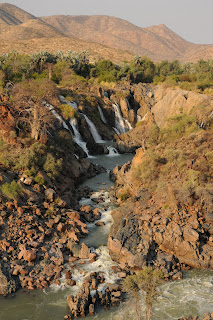
It didn't take long before we started to get some excellent views of the falls.  One of the first views is of the "main" falls, if you can call it that.  You will soon see that the Kunene river widens to about .5 km above Epupa Falls and the falls themselves are a series of many falls spread out over 1.5 km.
Main falls with campsite off to the right

Perhaps this helps one appreciate the lovely sound of falling water we enjoyed at our campground.

Further downstream we started to get other views of the falls located off to the left of the main cataract.

Section of falls with Baobab
Falls on the Angola side of the river
View of the island in the middle of the falls
We weren't just strolling to look at the falls.  We actually had a destination.  We were going to "the beach".
View downriver towards "the beach".  We walked on the left bank.
"the beach"
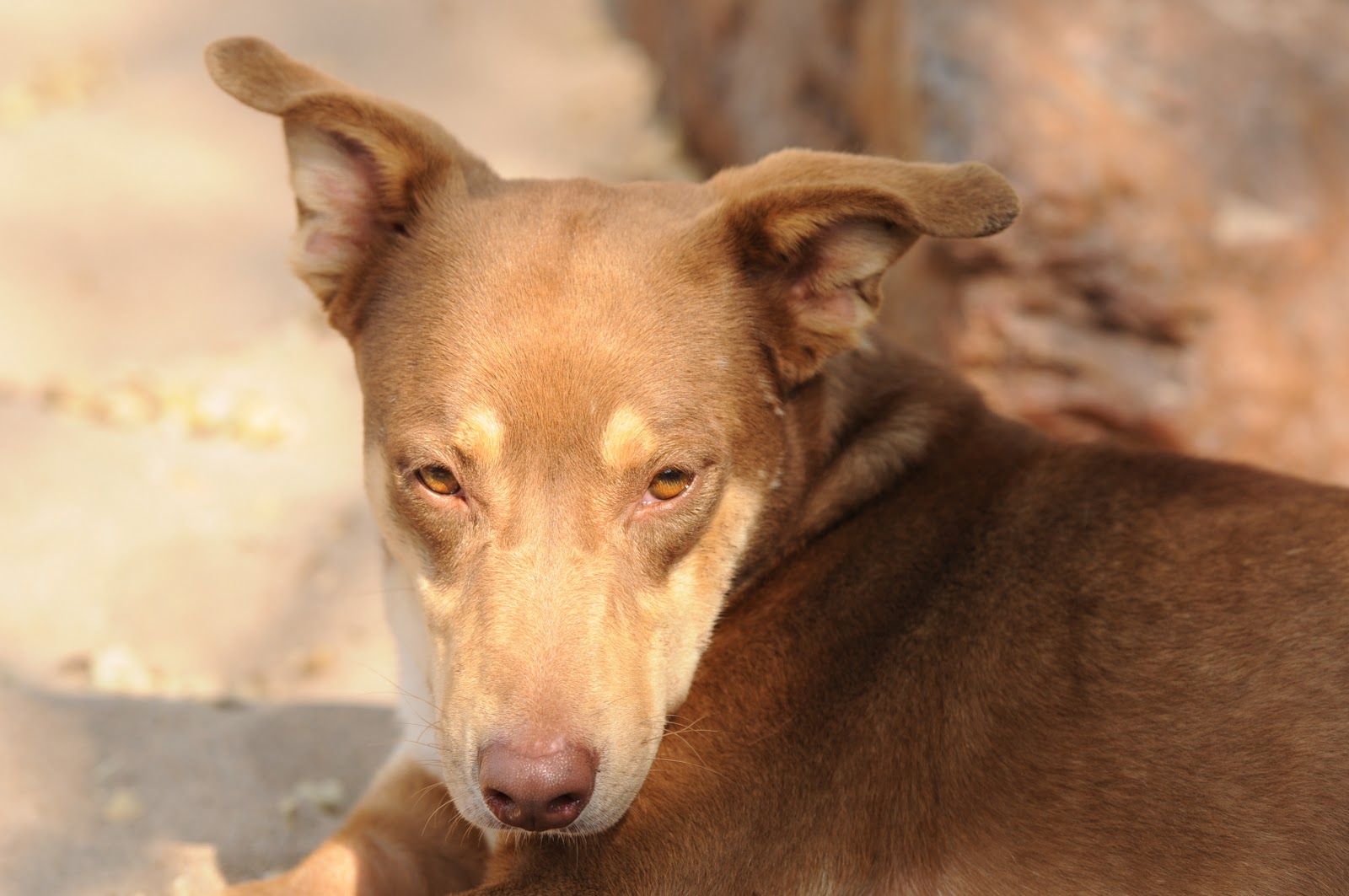
It was a beautiful walk...maybe 45 minutes to an hour.  We were not in a hurry.  Along the way there was a crude sign stating, "No swimming at the beach".  This was due to the crocodiles who like to sun themselves there.  We didn't see any crocodiles and we didn't meet any other people until coming back. We were fortunate to be accompanied by man's best friend, whom Roelof bonded with. 
Camp dog who lead the way and patiently waited under a tree for us to catch up
Rykie at the beach with flowers
Later that day Leon and Martie took Salome and I to the "sundowner" spot where the Henties doctor and his lovely wife the nurse provided us with medicine in the form of gin and tonic.  After all, quinine was the first effective treatment for malaria!
View of falls from "sundowner" spot
View of main falls.  Campground along river on right.
And that, along with another delicious meal, was the end of a perfect day!


Wednesday, 12 October 2011

Blogger's woes part 2...

Hello all and my apologies for being so late in posting!  Immediately after the Koakoland trip my friend Rene came from the US and we went to the Kruger for 11 days.  I thought I would have better internet connectivity in Kruger but that turned out not to be the case.  So I am just now resuming the blog and will start the Kruger blog once I'm finished with Koakoland.  Day 5 is where I restarted. Hope you enjoy! P

Tuesday, 11 October 2011

Day 5, Sept 13 – Epupa Falls Campground

We awoke to a beautiful day in a spot that I can only describe as magical.  There is an energy associated with moving water and here at Epupa Falls that energy can be felt with your entire being.  Over the next couple of days I took pictures of the falls in an effort to capture the magic but it is a place well worth visiting in person.
View of river from campground

We originally planned on camping at Omarunga campsite but after looking at Epupa falls campground we decided to settle in there among the Makalani plams.  Here we saw the red tailed palm thrush…which is found only in NW Namibia.
Campsite among Makalani palms
Roelof, Rykie, Tom, Salome and Nico
Tom and Nico enjoying a sundowner along the river

Almost all of the campsites we stayed at had some combination of amenities; such as laundry services, connection to electric power for charging batteries and cell connection.  At Epupa falls, there was an Herero woman who organized the locals to provide laundry services and to run the local gift shop.  Her name was Marianna and she was quite a gal! Since we had been on the road for a few days, I decided to take advantage of the laundry services…here is where I made my mistake and left my cell connection stick in my shirt pocket and it was thoroughly cleaned with the rest of my laundry.  After the cleansing, I tried to dry it out with Roelof’s help but unfortunately it could not be revived!  Without the cell stick I could not log on to the internet so that is where my blog started getting seriously behind.  It would have been further behind with out the help of Sean and Benita Braines, the managers of Omarunga Lodge.  This gracious and friendly couple let me use their internet and recharge my camera batteries. 

Sean's father, Steve Braine, is a well known naturalist who lives in Swakopmund.  He owned and ran Hobatere Lodge, outside of Etosha, until it tragically burned earlier this year.  Steve, his sons and John Lotter collectively own Batis Birding, which specialises in Namibia and Angola birding trips.  Sean's brother Dayne has taken one of the only pictures of Swierstra's Francolin (I think he said) found only in Angola and threatened with extinction.  And for camera buffs...Sean has a full frame Nikkon camera!!! Although I haven't been on a Batis Birding trip, the credentials of the owners must make for excellent trips and I can say that Sean's knowledge of birds was impressive.

Omarunga Lodge is a beautiful and well kept place within walking distance of Epupa Falls campground.  It has several chalets located in a peaceful setting along the river.

Later that day, the adventerous four; Dawn, Martie, Salome and I, decided to take another canoeing trip.  After all, the canoeing at Kunene Camp was a breeze and now we were experienced!  Unbeknownst to us class 3 rapids were waiting. 
Ready to load up for the trip upstream
After some hesitation I decided to take my camera along.  The canoeing/rafting company provided a waterproof bag that looked pretty strong and besides, my confidence was high.  Below are some photos taken during the truck ride upriver.

The "green" ribbon of river winding through the hills
Makalani palms along the river
Hang on gals!!
The river provides essentials for the survival of life
We arrive at our point of embarkation.
Ready for action!
Martie and guide on water
Group shot as we illegally stop in Angola for a drink (note welcome sign)
It was shortly after here that we hit some "big" rapids.  The bad news is that Salome and I failed "canoeing".  The good news is that we passed swimming!  Salome was in the front seat of the canoe and as we hit the main rapid I remember her flying gracefully through the air into the water.  I wasn't far behind her.  Fortunately the canoe didn't turn over and I was quickly able to grab onto the side.  Salome "popped" up shortly and we began our river trip outside the boat.  I was impressed by Salome's enthusiasim...she said "that was great!" immediately after popping up from the water.  We had just been thrown into crocodile infested waters but her spirits were high! 

6 foot crocodile seen just before being thrown from canoe
We were close to our destination so I did not take my camera from its waterproof bag.  I just hoped the bag worked!! Once we landed, I opened the bag and the camera was dry.

Note to self: Next time leave the camera behind on trips with class 3 rapids and higher!